
Businesses exporting pharmaceuticals, machinery, automotive parts, and food products all face the same baseline requirements: approved materials, sound construction, and airtight documentation. Miss one, and the shipment stalls at the border regardless of how good the product inside is.
This guide breaks down ISPM-15 rules, material choices, structural specs, labeling requirements, and how to pick a crating partner who won't leave you guessing.
Key Takeaways
- Wooden crates almost always need ISPM-15 heat treatment to clear customs without delays
- Match material and construction to cargo weight, fragility, and destination to avoid damage or rejection
- Treat labeling and documentation (HTS codes, ISPM-15 stamps, handling marks) as critical as the crate build itself
- Work with an ISPM-15 certified manufacturer to remove most of the compliance guesswork
Understanding ISPM-15 and Wood Packaging Compliance
ISPM-15 is the International Standard for Phytosanitary Measures No. 15, set by the International Plant Protection Convention (IPPC). It exists for one reason: raw wood packaging can carry pests and diseases across borders, and countries want that risk controlled before it reaches their soil.
Two treatments are approved; heat treatment is the one most exporters rely on today:
- Heat treatment (HT): Wood core must hold 56°C (133°F) for at least 30 continuous minutes throughout the profile, per the IPPC standard.
- Methyl bromide fumigation (MB): Still technically approved, but the standard encourages safer alternatives. Treat MB as a fading option, not a long-term plan.
U.S. Customs and Border Protection applies the same HT temperature and time requirement for wood packaging entering U.S. commerce.
What the IPPC Stamp Must Show
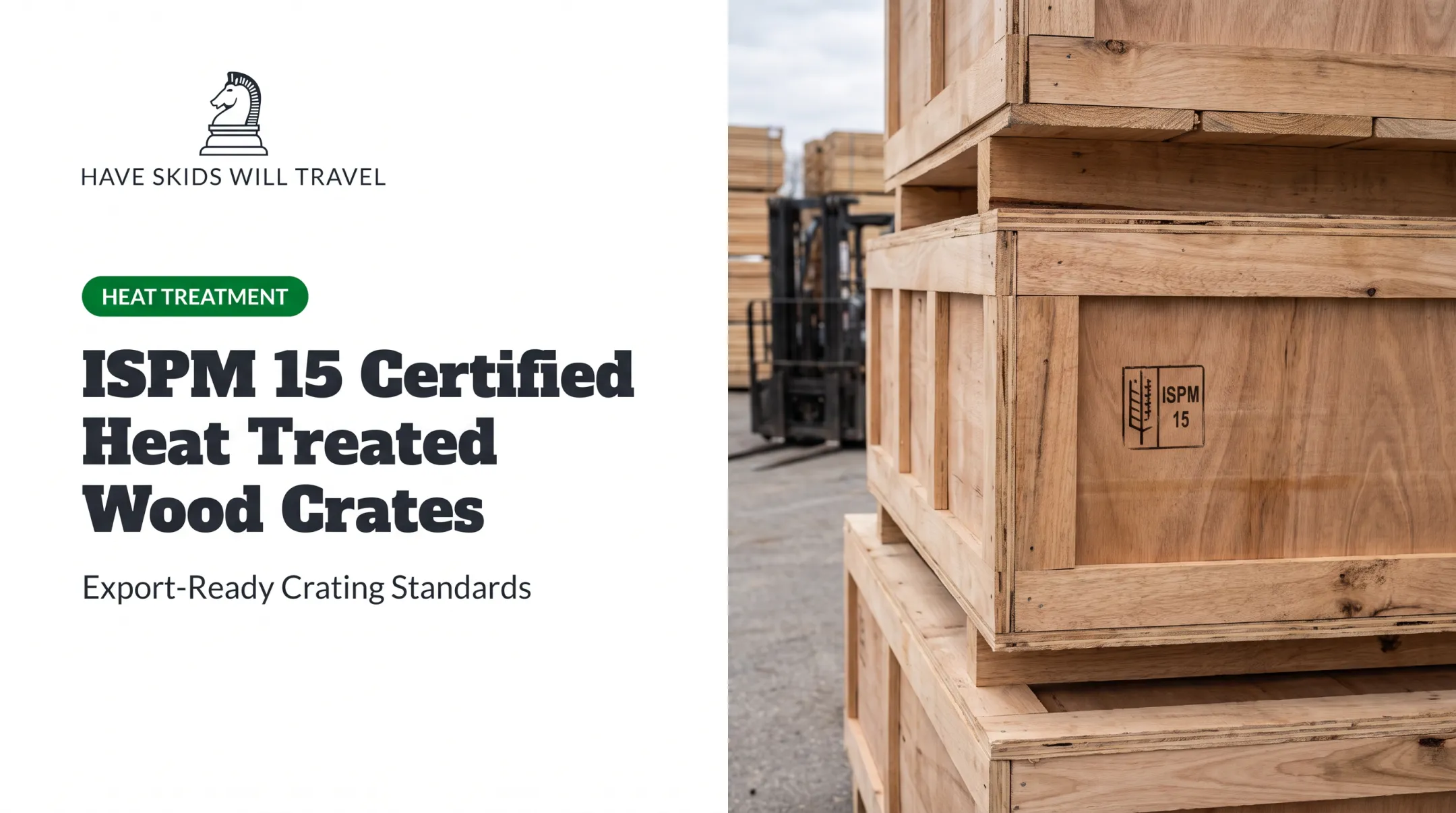
Every compliant crate needs a visible, legible mark containing:
- The IPPC logo
- A two-letter country code
- A unique producer or treatment-facility number
- The treatment code (HT or MB)
CBP requires this mark to appear on at least two opposite sides of the crate, and it needs to be permanent, not a sticker that can peel off mid-transit.

Non-compliance is expensive. CBP's mitigation guidelines allow penalties valued at the article itself, including the wood packaging, for unmarked or infested material, according to CBP's 2019 mitigation guidance.
First-time violations may see mitigation reduced by 1–10%. Repeat violations climb to 25% or more, and penalties can escalate further from there.
Materials That Skip the ISPM-15 Requirement
Not everything needs heat treatment. Manufactured wood products fall outside ISPM-15's scope entirely:
- Plywood
- Oriented strand board (OSB)
- Particleboard
- Hardboard
The catch: this exemption only applies when the entire component is manufactured wood. Mix in solid wood blocking or bracing, and that piece needs its own compliance check.
Palleton's Role in Compliance
Palleton holds ISPM-15 heat-treat certification for both pallets and crates. Each unit runs through monitored kilns that meet—and typically exceed—the required 56°C (133°F) core temperature for at least 30 minutes before the IPPC mark is applied. Exporters get HT-compliant pallets and crates from one certified source, with fewer vendors to vet and fewer compliance gaps at the border.

Material and Structural Specifications for Export Crates
Material choice depends on what the cargo must survive in transit, not unit cost alone.
| Material | Best For | Trade-offs |
|---|---|---|
| Heat-treated solid wood | Machinery, automotive parts, general freight | Requires ISPM-15 treatment for export |
| Plywood/OSB | Cost-sensitive shipments, lighter loads | Exempt from ISPM-15, but less load capacity |
| Plastic | Food-grade, moisture-sensitive goods | Lightweight, doesn't rot, higher upfront cost |
| Metal | Extremely heavy or high-value machinery | Corrosion risk without coating |
Structural Requirements
The ASTM D6039/D6039M standard covers wood crate construction for loads up to 4,000 lb. It requires crates to be fully assembled, square, and properly sized before shipment.
Blocking, bracing, and internal supports keep cargo from shifting. That protection matters on ocean freight, where a 20–30 day transit gives loose cargo plenty of time to cause damage.
Export crates need more than domestic ones. Longer transit times and rougher handling mean:
- Moisture barriers to block humidity swings inside ocean containers
- Desiccants to absorb residual moisture
- Shock-absorbing foam or padding for fragile components
- Corrosion protection on any exposed metal fasteners or brackets
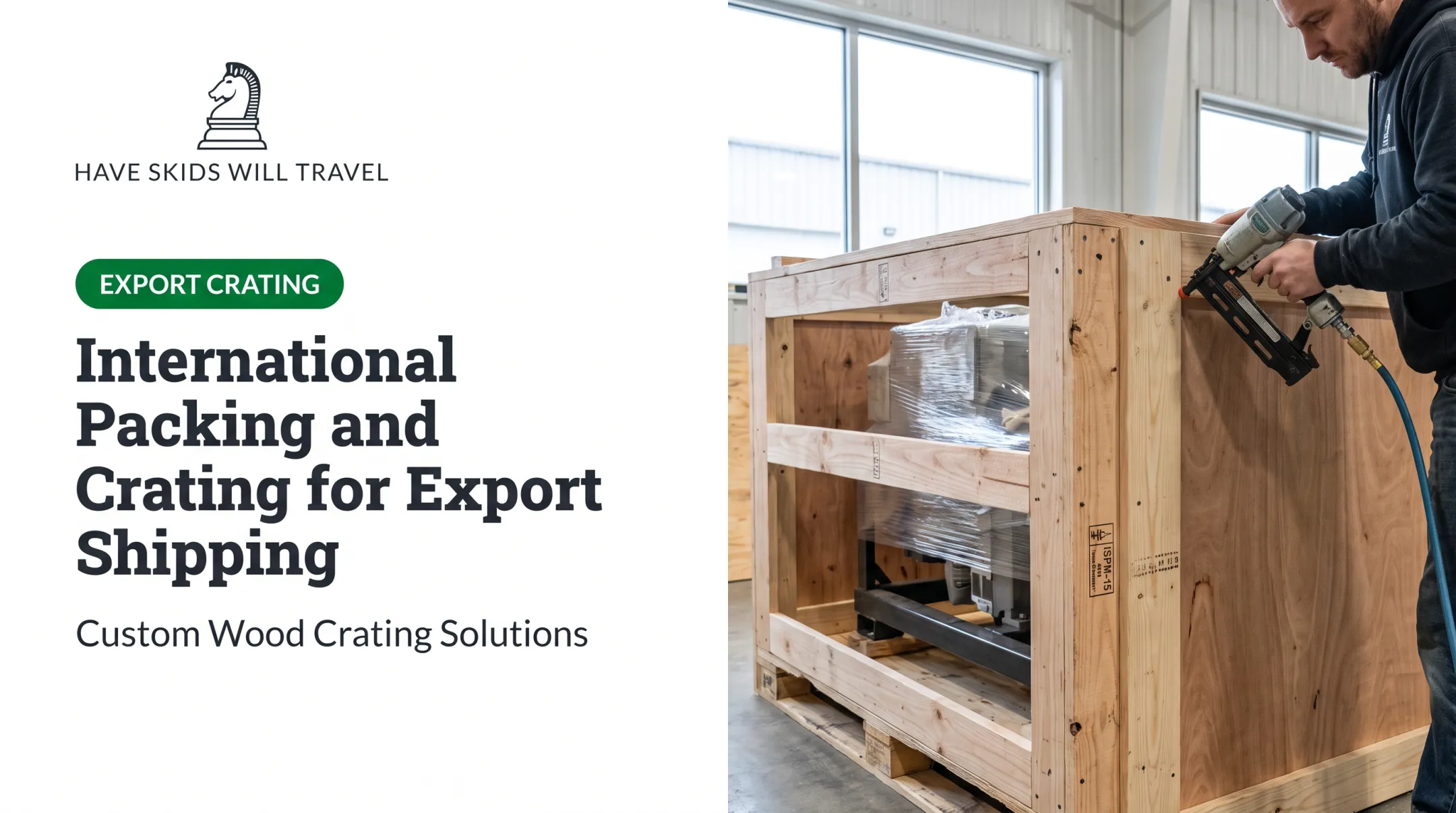
Palleton's custom-crate builds add padding, bracing, and climate-control options to heavy-duty reinforced construction. Each build is sized to the product's weight, fragility, and destination instead of a generic template.

Sizing for Container Efficiency
Standard 20-foot containers offer roughly 19 ft 4 in (5,900 mm) of internal length and 7 ft 8.5 in (2,352 mm) of width, according to Hapag-Lloyd's container specifications. Crates built too close to those limits, or with awkward dimensions that waste floor space, raise cost per shipment by cutting how many units fit in each container.
Labeling, Documentation, and Customs Requirements
A perfectly built crate still gets held at customs if the paperwork doesn't match.
Essential documents include:
- Commercial invoice
- Packing list
- Certificate of origin (when required)
- Bill of lading or air waybill
- Electronic Export Information (EEI) filing, required when a single Schedule B item's value exceeds $2,500
HTS codes matter more than most exporters realize. The Harmonized System uses a six-digit international base, but the U.S. requires a full 10-digit number for exports and imports, according to Trade.gov. Get the extension wrong and tariff calculations go sideways fast.
Required Crate Labeling
- ISPM-15 stamp (for solid wood packaging)
- Handling instructions: "Fragile," "This Side Up," lifting points
- Destination and consignee details
- Hazmat labels, if applicable
Before shipping, check the destination country's specific import restrictions — some nations ban certain wood species outright or impose size limits on wood packaging regardless of ISPM-15 status.
Weight, Design, and Cost Considerations
Crate dimensions and weight directly shape what you pay in freight. Carriers calculate chargeable weight by comparing actual weight against dimensional weight, then billing whichever is higher.
- Air freight: Dimensional weight = (length × width × height) ÷ carrier-specific DIM factor
- Ocean LCL: Volumetric weight uses a 1:1 density ratio based on cubic measurement
- Ocean FCL: A flat per-container rate applies instead of volume-based pricing

Oversized crates with excess air space inflate your dimensional weight without adding protection. Right-sizing the crate to the cargo, not the other way around, keeps costs down.
Custom-built crates justify their cost on irregular, heavy, or high-value cargo. Machinery and automotive components rarely fit standard crate sizes, and forcing them into an ill-fitting crate risks both damage and wasted freight spend.
Palleton's custom crate service reviews the product's weight, shipping requirements, and load capacity before designing dimensions that avoid excess material while still protecting the cargo.
Choosing the Right Crating Partner for International Shipments
Compliance risk multiplies when you're sourcing crates from a vendor who treats ISPM-15 as an afterthought. Look for:
- ISPM-15 certification with a documented heat-treatment process, not just a claim
- Custom design capability for irregular, heavy, or fragile cargo
- Consistent on-time delivery across recurring and one-off orders
- Clear lead-time communication, especially for time-sensitive shipments
Palleton has more than 45 years in the pallet and lumber industry, ISPM-15 heat-treatment certification, and custom pallet and crate manufacturing across seven facilities—including its own lumber mill. For businesses shipping machinery, automotive parts, or other export-bound cargo, that mix means fewer vendors to coordinate and fewer compliance questions left open.
Frequently Asked Questions
What is the difference between a standard shipping crate and an export crate?
Export crates use ISPM-15 certified, heat-treated materials with added reinforcement and moisture protection built for longer transit times and heavier customs scrutiny. Standard domestic crates typically skip these extra protections.
Do all wood crates need to be heat-treated for international shipping?
No. Only solid wood packaging requires ISPM-15 treatment. Plywood, OSB, particleboard, and other manufactured wood products are generally exempt from the standard.
What happens if my crate isn't ISPM-15 compliant?
Non-compliant crates risk rejection, fines, quarantine, or destruction at customs. Any of these outcomes can delay your shipment by days or weeks and add unplanned costs.
What information needs to be labeled on an international shipping crate?
At minimum: the ISPM-15 stamp, handling instructions like "Fragile" or "This Side Up," destination and consignee details, and hazmat labels where applicable.
How do I choose the right material for my export crate?
It depends on cargo weight, fragility, value, and destination-country regulations. Solid wood, plywood, plastic, and metal each fit different use cases based on those factors.
Can custom crate design actually reduce shipping costs?
Yes. Right-sized, well-engineered crates cut wasted space, lower dimensional weight fees, and reduce damage-related costs from poorly fitted packaging.