
Understanding the GMA pallet's standard footprint, construction options, load conditions, and quality variations matters before you place an order. This guide covers what GMA actually means, the real dimensions and specs behind the term, how common pallet types and grades compare, what affects load capacity, and a practical checklist for sourcing the right one.
Key Takeaways
- GMA typically means 48 × 40 in., the former Grocery Manufacturers Association footprint
- That footprint alone doesn't define material, grade, strength, or cleanliness
- Load capacity shifts under static, dynamic, or rack-supported conditions
- "GMA" doesn't mean new, hardwood, food-grade, or export-ready
- Always confirm the written specification before ordering
What a GMA Pallet Represents
GMA stands for Grocery Manufacturers Association, the trade group behind the pallet format that became the de facto US standard. The association rebranded as the Consumer Brands Association in January 2020, but the industry never stopped calling this pallet style by its original name.
Ask a pallet supplier for a "GMA pallet" today, and you'll get the same answer you would have 20 years ago: the 48 × 40 in. format.
The term identifies a widely adopted footprint and handling convention, not a fixed manufacturing formula. In metric terms, that's roughly 1,219 × 1,016 mm—useful when you coordinate with international suppliers or review freight documents.
The format spread because standardized dimensions make everything downstream simpler. Forklifts, pallet jacks, and racking systems get built around predictable sizes. When every pallet entering a warehouse shares the same footprint, storage planning and trailer loading both get easier.
A Footprint Isn't a Full Specification
Here's where buyers often trip up: a "48 × 40 pallet" and a pallet that satisfies a customer's complete GMA specification are not the same thing. A real buyer spec might require:
- Specific deck-board counts and thicknesses
- Stringer dimensions and spacing
- Entry type (two-way or four-way)
- Repair limits for recycled stock
- Cleanliness standards
- Minimum load performance under specified conditions
GMA pallets also come in several forms. At Palleton, standard GMA stringer pallets are available in:
- New hardwood
- New softwood
- Combo new-and-used wood
- 100% recycled wood
Each uses the same 48 × 40 in. footprint, with different cost and durability profiles.
Not every GMA pallet is food-grade or grocery-certified. The name reflects historical association with grocery distribution, not a guarantee of sanitary handling. Food-grade washed pallets are a separate product category, built to different processing standards.
GMA Pallet Size and Specification Range
The GMA label is a starting point. Actual performance on your dock or in your rack system depends on dimensions, material, construction, condition, and how the load is supported.
Standard Dimensions and Physical Characteristics
The standard footprint is 48 in. long by 40 in. wide. This affects everything from pallet position in a trailer to rack beam spacing to conveyor transfer compatibility.
Unloaded weight and height vary by construction. Industry estimates put a typical wood GMA pallet at roughly 44 to 59 lb, with height commonly falling between 4.5 and 4.75 in. depending on board thickness and design.
These aren't fixed numbers, though. Lumber species, moisture content, and repair history all shift the final figures.
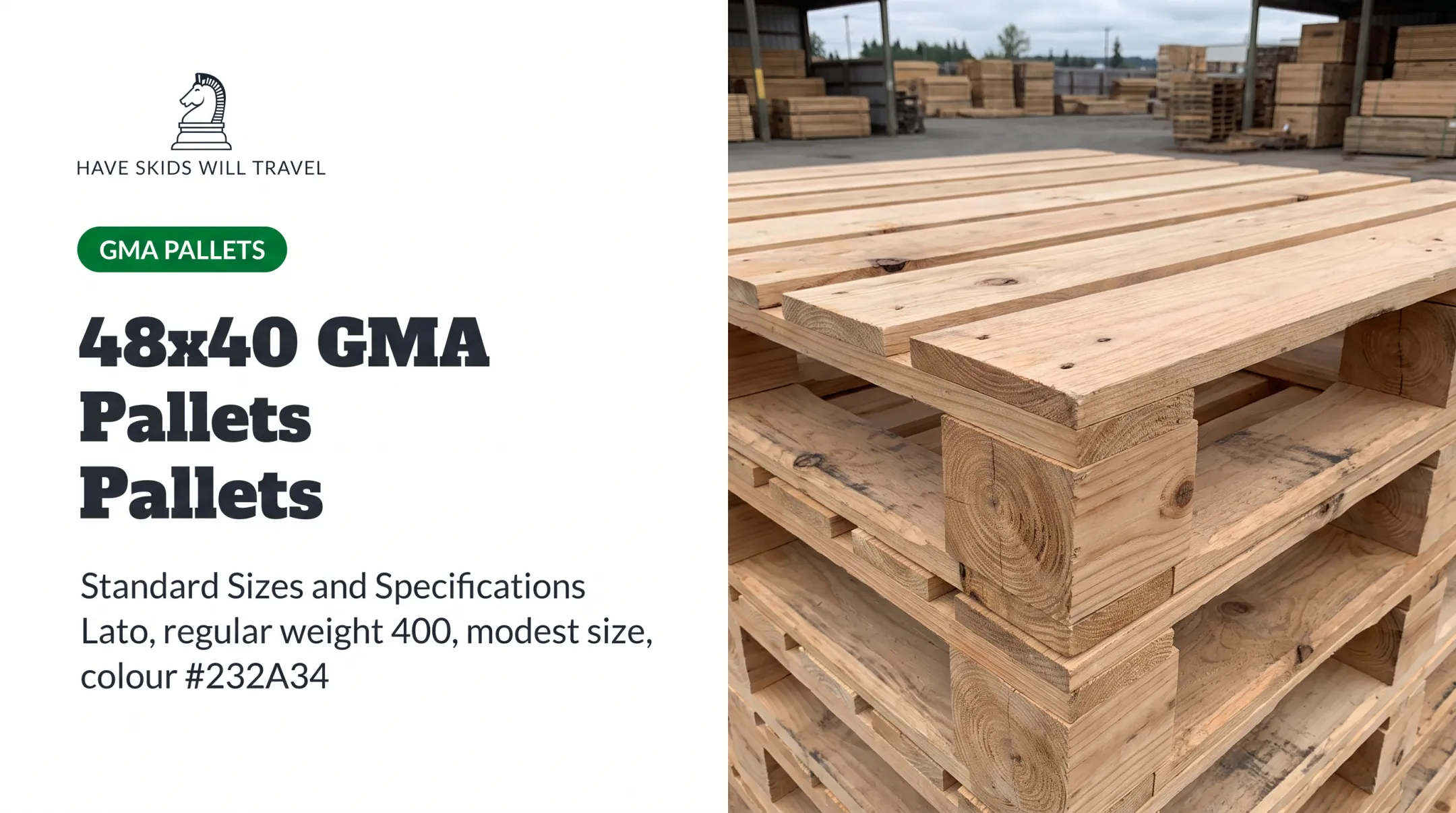
A documented GMA deck pattern uses:
- Seven top boards (two wide end boards plus five center boards)
- Five bottom boards (two wide end boards plus three interior boards)
That board layout matters for load distribution and for giving forklift tines and pallet jack wheels somewhere to engage safely.
Dimensional tolerances also matter more than people expect, especially in automated environments. Two pallets can share the same nominal 48 × 40 footprint and still differ by a fraction of an inch. That gap is enough to jam a conveyor or trip a sensor on an automated storage system.
Construction and Entry Options
Two structural styles dominate GMA pallet construction:
| Construction | How It's Built | Entry Pattern |
|---|---|---|
| Stringer | Continuous longitudinal beams support the deck | Unnotched: two-way only; notched: partial four-way |
| Block | Discrete blocks separate top and bottom decks | Often full four-way, depending on bottom-board layout |
Two-way entry means a forklift or pallet jack can only approach from two sides. Four-way entry allows access from all four sides, which matters in tight aisles or automated retrieval systems.
Don't assume "four-way" guarantees unrestricted access. Notched stringer designs often provide partial four-way entry only, not full clearance from every angle.
For unusual loads, reinforced and custom builds exist, too. Palleton's custom pallet program reviews product dimensions, load weight, and handling method to engineer heavier-duty designs for machinery, oversized freight, or concentrated loads with an unusual center of gravity.

Board count alone doesn't predict performance. Placement and support under the load do.
Materials and Common GMA Variations
Wood remains the dominant GMA material, but 48 × 40 options also include plastic, composite, and corrugated. Each trades off differently:
- Wood wins on repairability and cost
- Plastic offers better sanitation and consistent weight
- Corrugated fits light, single-use shipments
Within wood pallets, grade matters just as much as material. Common categories include:
- New - freshly manufactured, consistent board quality
- Premium recycled / Grade A (#1) - sounder stock, fewer major stringer repairs
- Grade B (#2) - more visible repairs, still structurally serviceable
A USDA Forest Service study on simulated handling found Grade A repaired pallets averaged 64 handlings before failure, compared to 52 for Grade B, while remanufactured pallets averaged even higher at 70. That's lab-simulated accelerated handling, not a guaranteed field trip count, but it shows that repair quality has a measurable effect on service life.
Grade definitions aren't standardized industry-wide, either. One supplier's Grade A isn't automatically identical to another's. When condition is critical, ask for photos, a written grade definition, or a sample pallet before committing to volume.
Load Capacity, Weight, and Height
There's no single "GMA capacity" number, and anyone who quotes one without context is oversimplifying. Load ratings change based on how the pallet is supported:
- Static capacity - load while the pallet sits still, fully supported underneath
- Dynamic capacity - load while being moved by forklift or pallet jack
- Rack-supported capacity - load while resting on rack beams with open space underneath
As one industry white paper on unit load design puts it, capacity figures only mean something when tied to a specific loading and support condition. A documented new 48 × 40 hardwood design rated by Great Lakes Pallet's design specification shows how much these numbers can vary by condition:
- 4,451 lb on shelf support
- 2,538 lb on forklift support, lifted from the end
- 5,481 lb stacked one unit load high
- 3,426 lb per pallet stacked two high

Those figures apply to one specific design under uniform, dry-condition loading. They're not a universal GMA rating. Point loads, overhang, uneven stacking, poor fork placement, and pallet moisture all reduce practical capacity below the rated figure.
Don't confuse empty pallet weight with maximum product load. Both matter for freight planning, but they answer different questions: one affects trailer weight limits and ergonomic handling; the other determines what the pallet can safely carry.
Maximum stack height is application-specific. Product stability, packaging strength, and trailer or rack clearance drive it more than the pallet itself.
Operational and Environmental Influences
Wood is a living material, and its behavior shifts with environment. Moisture content changes mechanical strength; most wood properties actually improve as moisture decreases, within limits. Heat, chemical exposure, outdoor storage, pests, and repeated handling cycles all chip away at structural performance over time.
A few practical notes:
- Repaired or mixed-lumber pallets keep the 48 × 40 footprint but vary in strength and board thickness
- Racking strength differs by orientation on new versus used pallets
- Automation, cold storage, food handling, and export often add requirements beyond the GMA footprint
How GMA Pallets Are Specified and Validated
Choosing the right pallet is a fit assessment, not a size match. The correct choice satisfies the product, the handling equipment, the storage system, the customer, the destination, and the budget together.
Specification and Documentation
Document these elements before ordering:
- Footprint and height tolerance
- Material and deck-board layout
- Stringer or block construction, entry type
- Grade and repair limits
- Capacity by load condition (static, dynamic, rack)
- Acceptable moisture or cleanliness condition
Distinguish rated values (tested under specific conditions) from estimated ones, and note who supplied each figure.
Retailer, food, pharmaceutical, automotive, or automation requirements can override a general GMA description. Confirm whether your customer needs new construction, recycled Grade A, washed food-grade, rack-compatible, or custom-built pallets.
Inspection and Verification
A basic receiving inspection should check:
- Broken or missing boards - look at both top and bottom decks
- Protruding nails or fasteners - safety hazard for handlers and product
- Cracked or repaired stringers - check repair quality, not just presence
- Contamination or mold - critical for food and pharma applications
- Excessive warping - affects stacking stability
- Marking legibility - especially for ISPM-15 stamps on export units
Verify actual footprint, height, and entry openings using consistent measuring methods, not a quick visual check. If pallets are headed into conveyors, automated storage systems, or a new receiving facility, run a trial load before committing to a full order.
Supplier Selection and Program Fit
Beyond the pallet itself, assess the supplier relationship: supply continuity, availability during demand spikes, lead-time communication, and repair or recycling support.
Palleton supplies standard, custom, recycled, and graded pallets and helps teams match options to operational requirements and budget. A consultation can clarify the spec—but it does not replace checking that delivered pallets meet your written requirements on arrival.
Export and Regulatory Checks
Wooden pallets crossing international borders often need ISPM-15 treatment: heat treating the wood core to at least 56°C (133°F) for 30 minutes, then marking it with an approved stamp.
According to USDA APHIS export guidance, destinations requiring compliant wood packaging include the EU, UK, Mexico, Australia, Japan, and India, among others, though the agency notes its list isn't exhaustive. A specific exception applies to continental US/Canada trade involving qualifying wood origin.
Palleton is ISPM-15 heat-treat certified for both pallets and crates, which covers the phytosanitary side of export shipping. Heat treatment only addresses pest and disease spread. It says nothing about load capacity, cleanliness, or food-grade status—those need separate confirmation.
Operating Outside the Recommended Specification
A pallet can have the correct 48 × 40 footprint and still fail on the floor if its condition, capacity, or support configuration doesn't match the job.
Common failure points include:
- Deck-board breakage under uneven loads
- Stringer splitting from repeated impact
- Full pallet collapse during lifting or stacking
- Load shifting in transit
- Rack incompatibility causing beam overhang
- Conveyor jams from dimensional inconsistency
Using a pallet below its required rating, or storing it outside approved conditions, leads to rejected loads, shipment delays, damaged product, and safety incidents. It's cheaper to specify correctly upfront than to replace a failed load mid-shipment.
A few misinterpretations show up constantly:
- Treating "48 × 40" as a complete spec
- Assuming GMA automatically means new hardwood
- Applying a static rating to a pallet that's actually moving
- Ignoring rack beam support conditions
- Expecting a repaired pallet to perform exactly like new stock
GMA vs. Euro pallets is another common point of confusion. The EPAL Euro pallet measures 1,200 × 800 mm, with different proportions from the GMA's 1,219 × 1,016 mm.
That difference affects trailer loading patterns, rack beam spacing, and container utilization. A 53-ft trailer holds about 26 pallets in a straight floor pattern with GMA dimensions; Euro pallets change that count. Always confirm which format your destination uses before locking packaging decisions.
When facing unusual loads, automated handling, rack storage, or export shipments, escalate to your pallet supplier, equipment provider, or a qualified engineer before finalizing a specification.
Conclusion
A GMA pallet is a widely adopted US format built around the 48 × 40 in. footprint. That label alone does not lock in material, grade, capacity, or condition.
Reliable specification still means checking construction, load type, support conditions, handling equipment, cleanliness, and destination together.
Before requesting a quote, gather:
- Product weight and dimensions
- Handling and storage requirements
- Required pallet grade
- Delivery destination
- Export needs, if applicable
With that information ready, a supplier conversation becomes a real specification discussion. Palleton can help match grade, construction, and treatment options to your load and destination requirements.
Frequently Asked Questions
What does GMA mean for pallets?
GMA refers to the Grocery Manufacturers Association, the trade group historically tied to this pallet format. Today it usually means the widely adopted 48 × 40 in. US pallet size, though construction and quality still vary.
What is a 48x40 GMA pallet?
It's a pallet with a 48 in. by 40 in. footprint. Material, height, entry type, grade, and load capacity are separate details—you can't assume them from the size alone.
How much weight can a 48x40 pallet hold?
Capacity depends on whether the load is static, dynamic, or rack-supported, plus the specific construction and condition of the pallet. Always use the manufacturer's or supplier's rating for your exact setup rather than a generic figure.
How much does a 40x48 pallet weigh?
Empty weight typically falls in the 44 to 59 lb range, but it varies by wood species, board thickness, moisture content, and repair history. Request the actual spec sheet for the pallet you're buying.
What are GMA Grade A pallets?
Grade A usually means higher-condition recycled or remanufactured 48 × 40 pallets with fewer major repairs. Written grade criteria still differ from one supplier to the next.
What are the standard pallet sizes?
The 48 × 40 in. GMA format is the US standard for grocery and general distribution. Other industries use different sizes, including 36 × 36 in. for beverages and 48 × 48 in. for chemical drums.