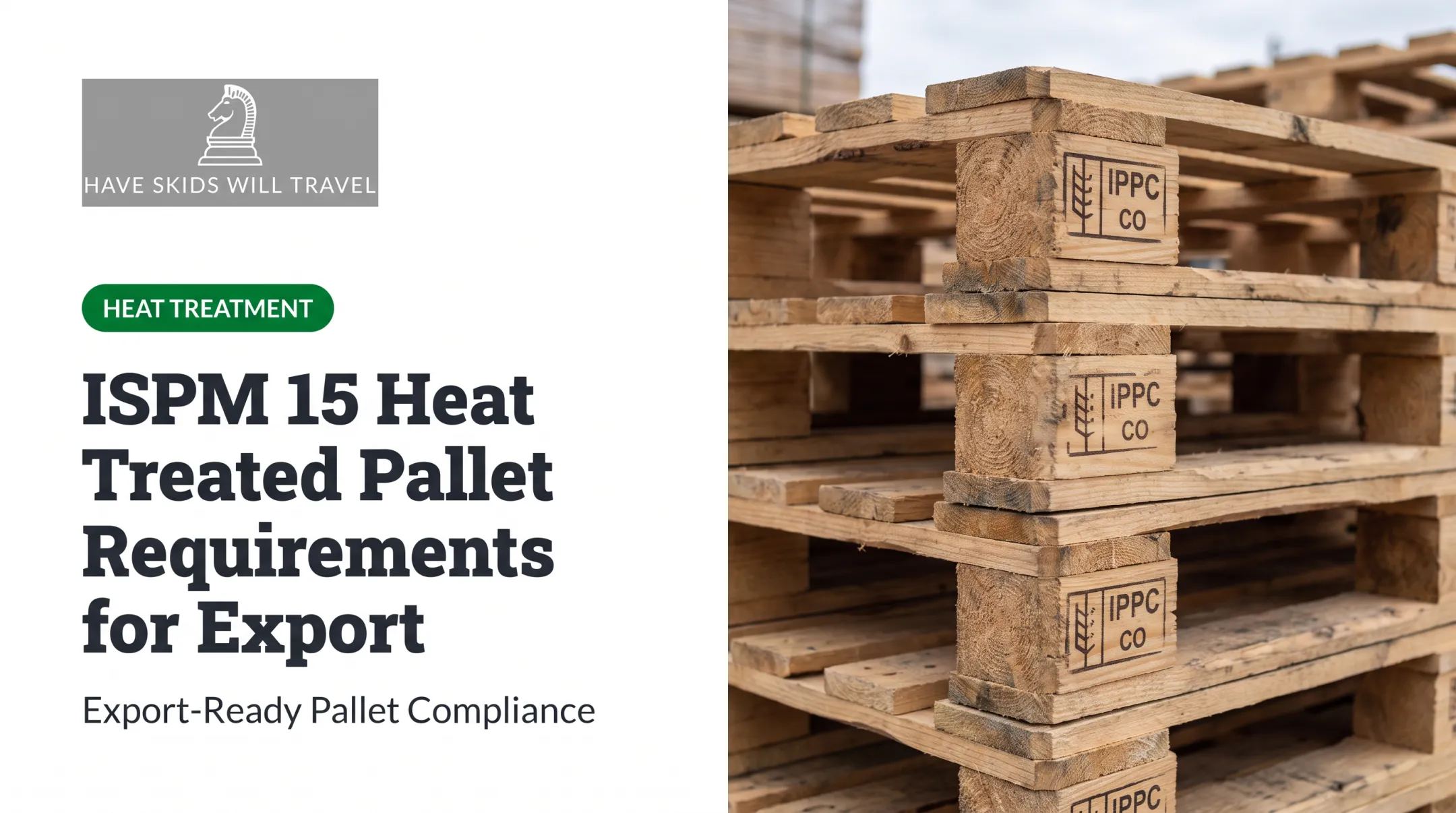

This happens more often than most shipping teams expect. ISPM 15 is the international standard requiring wood packaging material — pallets, crates, dunnage — to be heat-treated before crossing most borders. If you ship internationally, this isn't optional paperwork. It's a hard gate.
This article covers what ISPM 15 actually requires, how the heat-treatment process works, how to read the compliance stamp, and where to source pallets that won't get flagged at customs.
Key Takeaways
- ISPM 15 requires wood core temperature to hit 56°C (132.8°F) for 30 continuous minutes
- Most trading partners require ISPM 15; the US-Canada exemption is the rare exception
- The HT stamp combines the IPPC logo, country code, producer code, and treatment method (HT)
- Falsifying or misusing a stamp can trigger federal fines and criminal charges
- Sourcing from a certified provider like Palleton removes the guesswork from compliance
What Is ISPM 15 and Why Does It Exist?
ISPM 15 is a phytosanitary standard from the International Plant Protection Convention (IPPC), first adopted in 2002 and revised in 2009. Its job is simple: stop wood-boring pests and pathogens from hitching a ride across borders inside untreated wood packaging.
The standard covers non-manufactured wood packaging: pallets, crates, dunnage, and similar material. It does not cover finished wood products like plywood or particleboard.
Where it applies:
- Overseas exports — almost universally required
- Domestic US-to-Canada shipments — exempt, but only if the wood originated in the continental US or Canada and documentation proves it
According to industry group NWPCA/Woodpack Global, more than 100 countries have adopted ISPM 15 since its rollout. That's the vast majority of nations your business is likely trading with.
The Legal Risk of Getting It Wrong
Falsifying an ISPM 15 stamp is a federal offense. Under 7 USC 7734, knowingly forging or altering a treatment mark can mean up to five years in prison for a movement violation. Repeat offenses can bring up to ten years.
Civil penalties can run into six figures per violation. APHIS has confirmed enforcement actions involving fines as high as $100,000.
Don't guess on compliance, and don't accept a supplier's word without verifying the mark.
The ISPM 15 Heat Treatment Process, Step by Step
The core requirement is straightforward on paper: bring the wood to 56°C (132.8°F) throughout its entire profile, including the core, and hold it there for a minimum of 30 continuous minutes.
In practice, that requires precise equipment and process control. Here's how it typically works:
- Chamber loading — Pallets or crates are stacked in a kiln sized to allow even heat circulation.
- Probe insertion — Temperature probes are placed at the core of representative units, not just the surface.
- Heating cycle — The chamber runs until every probe confirms 56°C sustained for 30 minutes.
- Cool-down — Units rest before handling to prevent warping.
- Retrieval and marking — Compliant units are stamped with the ISPM 15 mark.
Reputable providers use automated kilns with data logging, creating a documented record tied to each batch: the paper trail customs officials and auditors can request.

Heat Treatment vs. Methyl Bromide Fumigation
ISPM 15 also permits methyl bromide (MB) fumigation as a treatment method. But MB is a chemical fumigant, and it's being phased out in several countries for environmental reasons, according to US Customs and Border Protection. Heat treatment has become the preferred method industry-wide because it's chemical-free and leaves no residue.
Don't Forget Debarking
Heat treatment alone isn't the full requirement. ISPM 15 also mandates that wood packaging be debarked, with only small bark fragments permitted (under 3 cm wide, or larger pieces under 50 square cm total). Skipping this step, even with a perfect heat cycle, can still create a compliance gap.
Understanding the ISPM 15 Heat Treat Stamp
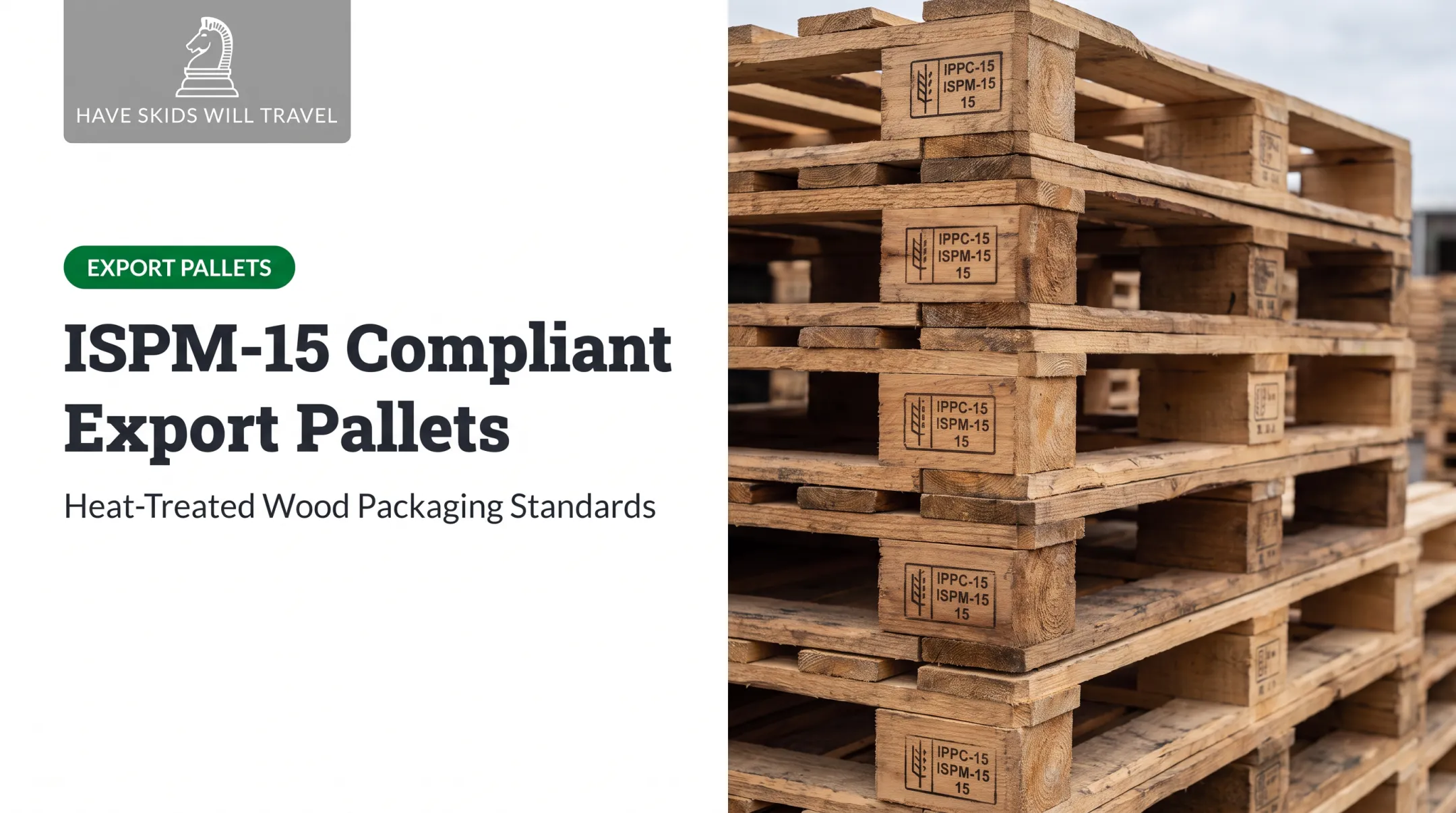
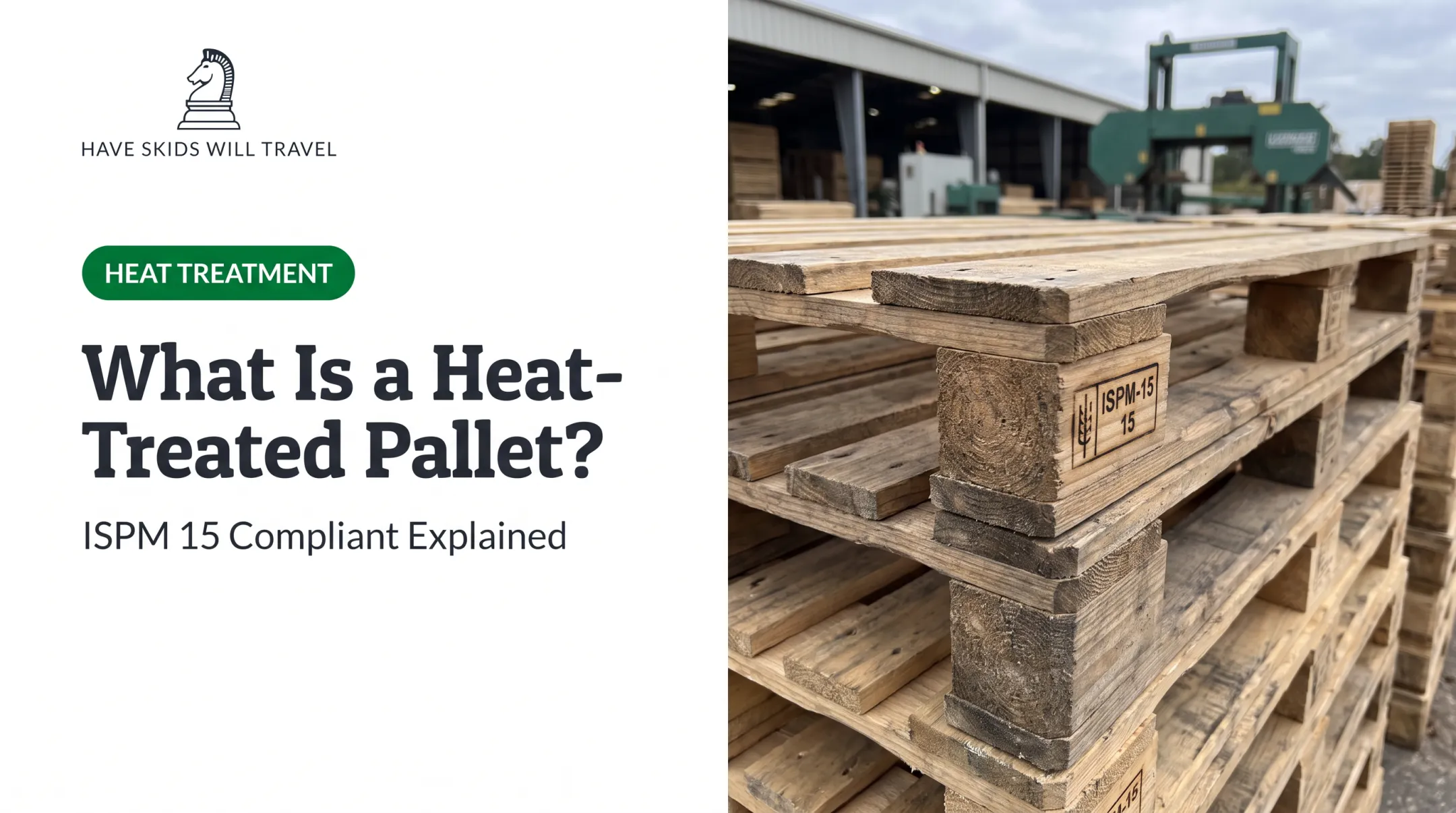
The stamp is the only thing a customs inspector actually sees. It has four required components:
| Component | What It Shows |
|---|---|
| IPPC logo | The internationally recognized "wheat" symbol |
| Country code | Two-letter ISO code (e.g., US) |
| Producer/facility code | Unique ID assigned to the certified facility |
| Treatment code | "HT" for heat treatment (vs. "MB" for fumigation) |
A typical mark reads something like US-02334 HT. It must be legible without a magnifying glass, durable, and visible — ideally on two opposite sides of the unit.

Only NPPO-approved or audited facilities can legally apply this stamp. In the US, that's coordinated through USDA APHIS, which authorizes the American Lumber Standard Committee (ALSC) to accredit inspection agencies overseeing the program.
The Repair and Re-Stamping Question
Under IPPC rules, an untouched, unaltered marked unit stays compliant for its full service life. No re-treatment is needed. Repair changes that:
- Replace up to roughly a third of components: added wood must be treated and marked individually
- Replace more than a third (remanufacture): obliterate the old mark, then re-treat and re-mark the entire unit
Many repair shops skip this step, which puts exporters at risk. When in doubt, treat a repaired pallet as non-compliant until proven otherwise. For export loads, source ISPM 15 heat-treated pallets from a certified facility such as Palleton rather than relying on unverified repairs.
Is Pressure-Treated Lumber the Same as Heat-Treated Lumber?
No — and this mix-up causes more customs holds than almost anything else.
- Pressure treatment injects chemical preservatives into the wood under pressure, primarily to prevent rot and decay in construction lumber
- Heat treatment (HT) relies solely on sustained high temperature, with zero chemical additives
Pressure-treated lumber does not meet ISPM 15 requirements, regardless of how durable or "treated" it sounds. Customs won't accept a pressure-treatment claim as a substitute for the official HT mark. If a supplier can't produce the stamp, it doesn't matter what chemicals went into the wood.

Common Questions on Sourcing, Care, and Compliance
Can heat-treated pallets get wet?
Yes. HT certification is permanent once applied; getting wet doesn't strip the mark. Prolonged moisture can still cause mold or structural weakening, so keep wood moisture under roughly 20% per Pallet Enterprise. Treat wetness as a durability issue, not a compliance issue.
Where can I buy ISPM 15 compliant pallets?
Source from a certified provider with audited facilities, not verbal assurance alone. Palleton is ISPM-15 heat-treat certified across seven facilities and can build treatment into orders for hardwood pallets, combo pallets, or custom export crates. Using one provider for purchasing and certification also reduces mismatched compliance paperwork on mixed domestic and export loads.
Frequently Asked Questions
What are heat-treated pallets?
Heat-treated pallets are wood packaging processed to kill pests and pathogens so the wood meets phytosanitary import rules. They’re used mainly for international shipping where ISPM 15 compliance is required.
What are the requirements for ISPM 15 wooden pallets?
Wood must be debarked, heat-treated to a core temperature of 56°C (132.8°F) for at least 30 minutes, and marked with the official HT stamp showing the IPPC logo, country code, and producer code.
Are heat-treated pallets required for international shipping?
Yes. Most international shipments need ISPM 15-compliant wood packaging. Domestic moves within the continental US, or between the US and Canada, are exempt when the wood originates there.
Which countries require heat-treated pallets under ISPM 15?
More than 100 countries have adopted the standard, covering nearly all major global trading partners.
How can you tell if a pallet has been heat treated?
Look for the official stamp on the pallet's stringer (the long support beam). It should show the IPPC symbol, a two-letter country code, a facility ID number, and the letters "HT."
Can heat-treated pallets get wet, and does that void certification?
No, wetting alone doesn't void the ISPM 15 mark since the treatment is permanent. Prolonged moisture exposure can still cause mold or weaken the pallet's structural integrity over time.